Informative webinar on Investing in Pakistan held on 5 May 2026
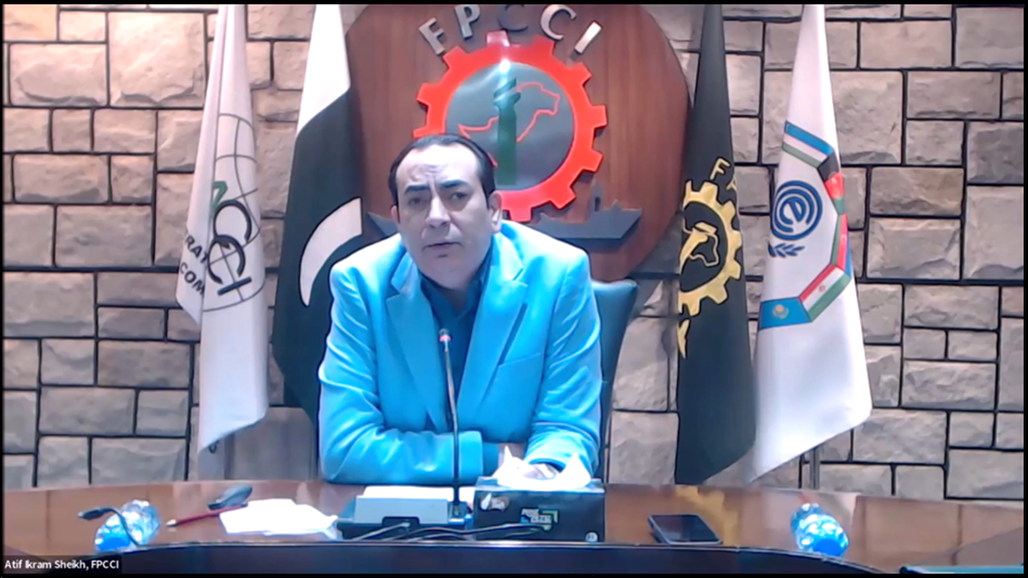
On May 5 2026, CACCI and the Federation of Pakistan Chambers of Commerce and Industry (FPCCI) held a very informative webinar on Doing Business in Pakistan: Current Trends and Latest Developments.
The 60-minute session featured Mr. Atif Ikram Sheikh, President of FPCCI and the Economic Cooperation Organization Chambers of Commerce and Industry (ECO CCI), Vice President of CACCI, and CEO of Mujahid Group of Industries, while Darson Chiu, Ph.D., in his capacity as CACCI Director-General, delivered the Welcome Remarks. The session concluded with a Q&A session with Mr. Atif Ikram Sheikh moderated by Mr. Mig Moreno, Deputy Director-General of CACCI. Hereunder is a summary of the session:
 Welcome Remarks
CACCI Director General Darson Chiu, Ph.D., welcomed participants by highlighting Pakistan’s strategic importance as a key South Asian economy with a large market, young workforce, and strong regional connectivity. He noted that amid global shifts in supply chains, digitalization, and geopolitics, understanding emerging markets like Pakistan is increasingly essential for business diversification. He also emphasized CACCI’s role in fostering regional collaboration and expressed confidence that the session would strengthen economic linkages between Pakistan and the Asia-Pacific.
Presentation Summary
Mr. Atif Ikram Sheikh presented an overview of Pakistan’s evolving economic landscape, underscoring its growing relevance as an emerging market. He highlighted the strong partnership between FPCCI and CACCI in promoting regional cooperation and outlined a generally positive macroeconomic outlook, supported by moderate GDP growth, improving inflation, and favorable projections. With a population exceeding 250 million and a consumption-driven economy, Pakistan offers a large and expanding domestic market supported by remittances and a rising middle class.
He noted that the services sector dominates the economy, followed by agriculture and industry, with all sectors showing growth momentum. While a trade deficit persists, Sheikh emphasized this creates opportunities for investment in export-oriented and import-substitution industries. Strengthening foreign exchange reserves, improving credit outlook, and extensive trade partnerships—including preferential access to the European Union—further enhance Pakistan’s investment appeal.
Pakistan’s strategic geographic location was highlighted as a major advantage, positioning it as a regional trade and logistics hub linking Central Asia, the Middle East, and Asia-Pacific. Infrastructure expansion and connectivity initiatives are improving trade efficiency and reducing costs. Sheikh also emphasized the country’s young and skilled workforce as a key driver of long-term growth and competitiveness.
Mr. Atif outlined investor-friendly policies, including 100% foreign ownership, legal protections, tax incentives, and bilateral investment agreements. Government initiatives such as the “Uraan Pakistan” plan and the development of Special Economic Zones (SEZs) reinforce efforts toward industrialization and export-led growth, offering incentives like tax exemptions and duty relief to investors.
Key sectors identified for investment by Mr. Atif include agriculture, logistics, textiles, automobiles, IT, construction, tourism, and renewable energy. He highlighted strong potential in IT exports, digital infrastructure, and emerging areas such as e-commerce, electric vehicles, and clean energy. He concluded by emphasizing FPCCI’s role in supporting investors and facilitating engagement through platforms like the Special Investment Facilitation Council, reinforcing Pakistan’s position as a promising investment destination.
Key Takeaways
- Pakistan offers a large, consumption-driven market supported by strong demographics.
- Strategic location and connectivity enhance its role as a regional trade hub.
- Pro-investment policies and SEZ incentives improve the business environment.
- High-growth sectors such as IT, energy, and infrastructure present strong opportunities.
Q&A Highlights
Moderated by Mr. Mig Moreno, the Q&A session addressed key investor concerns. Mr. Atif noted that earlier challenges such as high interest rates and energy costs have eased, improving competitiveness, while ongoing reforms aim to further enhance the business environment. He confirmed that foreign investors can establish companies remotely, supported by institutions like the Special Investment Facilitation Council (SIFC), although in-person engagement remains beneficial.
On external factors, Mr. Atif stated that regional geopolitical tensions have had minimal impact on Pakistan’s economic activity. He highlighted Pakistan’s competitive advantage through fiscal incentives, upcoming policy support, and continued reforms. Key sectors with strong growth potential over the next 3–5 years include IT, construction, food processing, and mining, particularly in mineral-rich regions.
Mr. Atif also pointed to improving cost structures, including declining interest and energy rates, as critical for industrial competitiveness. Looking ahead, he expressed optimism about Pakistan’s trajectory, suggesting the country could emerge as a leading regional economy, supported by policy reforms, demographics, and strategic positioning.
A copy of the presentations was disseminated among the participants.
A video recording of the webinar can be viewed at the CACCI YouTube.