Business Opportunities in Mongolia discussed on 24 March 2026
On 24 March 2026, the Confederation of Asia-Pacific Chambers of Commerce and Industry (CACCI) and the Mongolian National Chamber of Commerce and Industry (MNCCI) held the webinar on “Mongolia’s Business Opportunities.”
Hereunder is a summary report on the webinar.
Opening Session
The webinar opened with Solongo Enkhsaikhan, MNCCI Head of Foreign Affairs and Cooperation, welcoming participants and setting the objective of showcasing Mongolia’s economic outlook and investment opportunities.
This was followed by Peter McMullin, CACCI President, emphasizing regional cooperation through sustainability, entrepreneurship, and trade, positioning Mongolia as a dynamic, resource-rich and increasingly strategic economy within the Asia-Pacific.
Thereafter, Lkhagvajav Baatarjav, MNCCI President, highlighted MNCCI’s role as a key facilitator for foreign investors through advocacy, partnerships, and market entry support.
Main Presentations
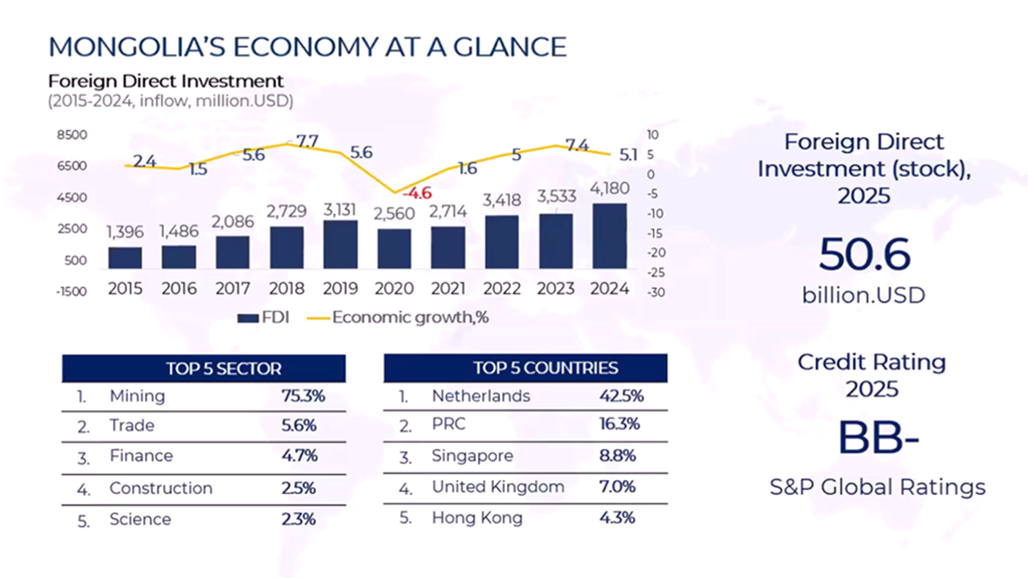
Saruul Bulgan, MNCCI Secretary General, outlined Mongolia’s strong macroeconomic fundamentals, including USD 25.4 billion GDP, 6.8% growth, and upper-middle-income status, supported by an open trade regime with 160 countries, though still highly dependent on mining exports (coal, copper, gold).
China remains its dominant export destination and Russia and Japan are key import partners, while the government is actively pursuing diversification into cashmere, meat, and value-added industries, alongside efforts to expand trade with Southeast Asia and attract broader foreign investment beyond the mining sector.
Mongolia’s investment appeal is driven by its strategic location between China and Russia, vast untapped natural resources (with only 5% of land licensed), and growing policy support for diversification and sustainability, complemented by renewable energy potential (notably wind and solar).
The government has signed multiple trade agreements (EU GSP+, APTA, Japan EPA, and Eurasian FTA), established a relatively competitive tax regime (10% standard corporate tax), and constructed a pipeline of 14 national and 24 city-level mega projects, while agriculture (meat exports, cashmere, leather) and infrastructure—particularly via PPP models—offer significant expansion opportunities.
- Economic structure: strong growth but concentrated in mining, with increasing push toward diversification
- Investment framework: open economy, USD 50B cumulative FDI (mainly mining), improving regulatory and trade environment
- Sector opportunities: mining, agriculture, renewable energy, and large-scale infrastructure projects
- Market positioning: use Mongolia as a production and export base leveraging FTAs
Unenbat Baatar, Mobicom Chief Strategy Officer, presented Mobicom Corporation as a leading example of successful foreign investment (backed by KDDI Group), demonstrating Mongolia’s rapid digital leapfrogging, with 1.8 million subscribers, ~40% market share, and near-universal population coverage.
Its vast network exhibits fast 5G adoption (60% market share within seven months) enabling expansion into enterprise solutions, AI, cloud, and fintech, including a SuperApp ecosystem and innovative bundled services such as telecom-based insurance, reflecting convergence across telecom, finance, and digital services.
Some of the features in the market include:
- Digital infrastructure: extensive coverage and rapid 5G-driven innovation
- Business expansion: enterprise solutions, AI, cloud, and data-driven services
- Fintech ecosystem: e-money, lending, e-commerce, and integrated SuperApp platform
- Partnership areas: cloud (e.g., Amazon Web Services), cybersecurity, blockchain, and advanced financial services
Panel Discussion
The panel discussion underscored that Mongolia remains mining-dependent but is gradually diversifying, including oil development and renewable energy, while the financial sector is bank-dominated with high lending rates and an underdeveloped capital market, prompting reforms to attract foreign investment, expand listings (including cooperation with the London Stock Exchange).
There are discussions to potentially allow international banks, although regulatory sensitivities remain, particularly around strategic assets; additionally, speakers emphasized that joint ventures and trusted local partnerships are essential for market entry, and highlighted tourism as a growing sector supported by national promotion efforts and rising international arrivals.
A video recording of the webinar can be viewed at the CACCI YouTube HERE