Comprehensive webinar on Sri Lanka in a Changing Global Economy held on 14 July 2026

The Confederation of Asia-Pacific Chambers of Commerce and Industry (CACCI) and the Ceylon Chamber of Commerce, a Primary Member of CACCI, held a comprehensive webinar on “Positioning Sri Lanka in a Changing Global Economy: Resilience, Reform and the Future of Economic Policy,” on 14 July 2026.
The webinar reviewed the country’s transition from the 2022 crisis toward stability and renewed growth. Speakers discussed the IMF-supported reforms and improvements in inflation, reserves, exports, tourism, and private-sector activity. The event also previewed the Sri Lanka Economic and Investment Summit, scheduled for 12–13 October 2026 in Colombo. Here is the summary of the presentations and panel discussion.
(1) Welcome Remarks by Peter McMullin AM, President of CACCI
CACCI President Peter McMullin AM welcomed the participants to the webinar. He proceeded to describe CACCI as a network of 27 business associations promoting cooperation, trade, and economic collaboration across the Asia-Pacific region.
He emphasized CACCI’s Sustainability, Entrepreneurship and Trade (SET) agenda. Amid geopolitical fragmentation, he stressed the importance of dialogue, trust, and regional cooperation. He expressed support for the Sri Lanka Economic and Investment Summit scheduled to take place in October and encouraged continued collaboration among member chambers.
(2) Introductory Remarks by Krishan Balendra, Chairperson of the Ceylon Chamber of Commerce
Krishan Balendra thanked CACCI for its longstanding partnership with the Ceylon Chamber of Commerce (CCC). He said the relationship was based on regional cooperation, private-sector leadership, and stronger Asia-Pacific business networks, adding that the Chamber serves as a bridge connecting businesses, investors, and partners.
Mr. Balendra noted Sri Lanka’s strong recovery from the 2022 crisis, pointing out that growth had resumed, inflation moderated, reserves improved, and tourism and exports regained momentum. He further added that political and macroeconomic stability had also strengthened under the IMF-supported reform program.
The CCC Chairman said that Sri Lanka was now moving from stabilization toward sustainable growth driven by structural reform, private investment, and regional integration. He invited CACCI chambers to send delegations to the October Summit to meet policymakers, industry leaders, project sponsors, and potential partners.
(3) Presentation by Arani Rodrigo-Weeraseskera, Economist at the Ceylon Chamber of Commerce
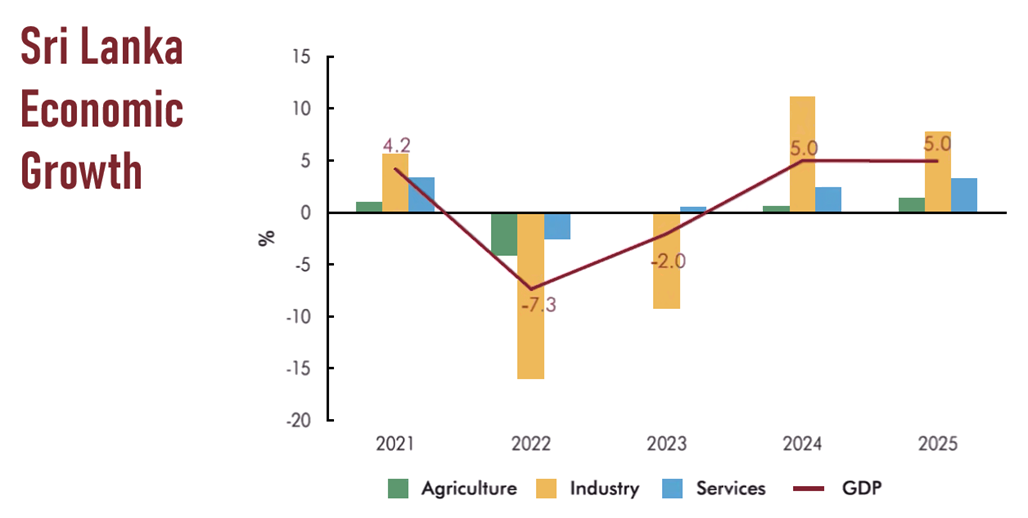
Ms. Arani Rodrigo-Weeraseskera outlined Sri Lanka’s transition from crisis to stability. She noted that after severe economic difficulties in 2022 and 2023, the economy grew by approximately five percent in 2024 and 2025. Growth reached 5.1 percent during the first quarter of 2026, while per-capita GDP also improved.
She highlighted the country's lower inflation, more stable interest rates, stronger private-sector credit, and improved fiscal management. Sri Lanka maintained positive primary balances and completed important IMF program reviews, demonstrating progress in restructuring public finances and restoring confidence, she pointed out.
She further noted that the external position improved through tourism, workers’ remittances, positive current-account balances, and higher reserves; that official reserves reached approximately US$6.8 billion in 2025 and remained relatively stable in 2026, helping the country absorb external shocks; and that Sri Lanka’s investment strengths include its skilled workforce, strategic location, human capital, digital capabilities, and transshipment role.
Rodrigo-Weeraseskera concluded that future growth would depend on regional trade, reform, digitization, automation, and competitive export industries.
(4) Presentation on the Sri Lanka Economic and Investment Summit by Shiran Fernando
Mr. Shiran Fernando introduced the Sri Lanka Economic and Investment Summit as the Chamber’s main platform for connecting economic reform with investment. She said that the event will be held in Colombo on 12 and 13 October 2026, allowing participants to meet policymakers, government agencies, business leaders, and project sponsors.
Mr. Fernando highlighted that the summit will showcase investment and joint-venture opportunities through government institutions and Chamber members; that priority sectors include agriculture, apparel, manufacturing, technology, infrastructure, education, energy, healthcare, and tourism; and that the previous summit attracted more than 850 participants, including over 100 foreign investors.
He further added that the first day will include an investment panel, meetings with public agencies, business-to-business engagements, and an inaugural session expected to involve Sri Lanka’s President, noting that investors will be able to meet representatives of key regulatory, trade, revenue, and investment institutions.
Mr. Fernando pointed out that the second day will cover the macroeconomic outlook, trade corridors, education, healthcare, energy, and policy, and that visits to investment zones, export facilities, and Port City Colombo may also be arranged. The summit aims to produce concrete investments, partnerships, and commercial relationships, she concluded.
(5) Summary of the Question-and-Answer Session
The question-and-answer session examined Sri Lanka’s recovery and priority investment sectors. Mr. Fernando moderated the discussion with Mr. Balendra, Ms. Rodrigo-Weeraseskera, and Mr. Hirdaramani. Tourism, manufacturing, logistics, consumer industries, digital services, minerals, construction, and regional trade emerged as leading opportunities.
Mr. Balendra described tourism as a major growth sector. Arrivals rose from approximately 300,000–400,000 annually during the civil-war period to more than two million before the pandemic. He remarked that Sri Lanka still attracts fewer visitors than many competing Asian destinations, leaving considerable room for expansion.
He further pointed out that India is expected to become an increasingly important tourism market, that Indian visitors already account for approximately 20–25 percent of arrivals, and that Sri Lanka’s proximity and diverse attractions create opportunities in hotels, resorts, transportation, entertainment, and related infrastructure.
Mr. Hirdaramani highlighted Sri Lanka’s strengths in export manufacturing, particularly apparel. He noted that the industry has maintained its position through sustainability, transparency, specialized production, and value-added products.; that Opportunities also exist to connect with South Indian electronics, automotive, and manufacturing supply chains; that mineral sands, information technology, artificial intelligence, and professional services offer further potential; and that Sri Lanka’s literacy levels and skilled workforce provide a strong foundation, although education and training must adapt to technological change.
Ms. Rodrigo-Weeraseskera said the recovery was supported by debt restructuring, IMF-backed reforms, fiscal adjustment, and stronger external accounts; that lower inflation, improved reserves, growth, and better fiscal performance demonstrated restored stability and resilience; that future growth will depend on exports, tourism, agriculture, digitization, and regional cooperation; and that digital public services and modernized logistics could reduce business costs, raise productivity, and connect Sri Lankan firms with larger markets and supply chains.
Mr.. Balendra also noted the recovery of consumer demand. He explained that despite high inflation and rising prices, sales of several discretionary products returned to pre-pandemic volumes by 2024, and that modern retail, housing, construction, and household-related industries were therefore considered promising.
The Port of Colombo, which is South Asia’s largest container port, was identified as another major opportunity, handling substantial transshipment cargo linked to India. Its deep-water facilities and location along east-west shipping routes provide important advantages. Further investment in port capacity, warehouses, logistics parks, and cargo consolidation could strengthen Colombo’s regional role.
The speakers emphasized that macroeconomic stability must support entrepreneurship and private-sector growth and that government-business cooperation is needed in investment, employment, innovation, energy, and workforce development.
Mr. Fernando also noted that Sri Lanka’s trade agreements, preferential access to European and British markets, and application to join the Regional Comprehensive Economic Partnership could deepen regional integration and support investment-led growth.
A copy of the presentations was distributed to all the participants.
A video recording of the webinar can be viewed at the CACCI YouTube.