CACCI, FPCCI & FBCCI Jointly Hold Webinar on the Textile Industry

The Confederation of Asia-Pacific Chambers of Commerce and Industry (CACCI), the Federation of Pakistan Chambers of Commerce and Industry (FPCCI) and the Federation of Bangladesh Chambers of Commerce and Industry (FBCCI) would like to thank you for participating in the informative webinar on “Textile Industry in the Asia-Pacific Region: Opportunities, Challenges and the Way Forward” held on 23 September 2026.
The webinar brought together senior representatives from Pakistan and Bangladesh to discuss the current state of the textile and garment industry, export opportunities, technological transformation, sustainability requirements and prospects for stronger regional cooperation.
 Opening Remarks
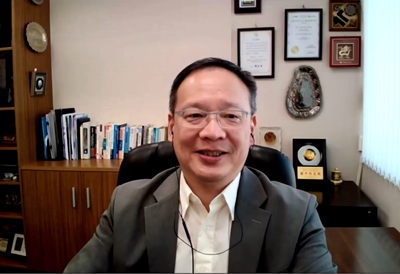
Dr. Darson Chiu, Director-General of CACCI welcomed participants and expressed appreciation to FPCCI for jointly organizing the webinar. He also welcomed the two featured speakers, Mr. Atif Ikram Sheikh, President of FPCCI and ECO-CCI and Vice President of CACCI, and Ms. Vidiya Amrit Khan, Vice President of the Bangladesh Garment Manufacturers and Exporters Association.
Dr. Chiu highlighted the textile and garment industry’s important contribution to employment, trade and regional supply chains. He noted that Pakistan’s textile and apparel exports reached nearly US$18 billion, while Bangladesh recorded more than US$39 billion in ready-made garment exports. At the same time, the sector is being reshaped by changing global demand, rising production costs, restructuring of supply chains, technological developments and growing sustainability requirements.
He expressed his hope that the webinar would help CACCI members better understand these developments and identify new opportunities for trade, investment, technology cooperation and regional business partnerships.
Pakistan Textile Market
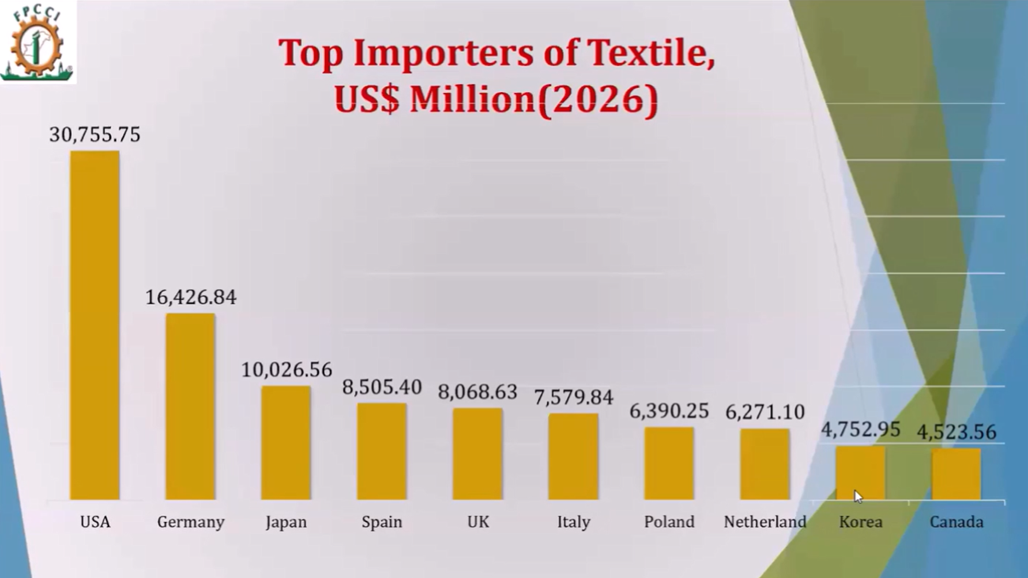
Mr. Atif Ikram Sheikh described the textile industry as one of the most important economic sectors in the Asia-Pacific region and stressed the need for closer regional cooperation.
He noted that the global textile market was valued at approximately US$2.12 trillion in 2025 and is expected to expand significantly by 2035, supported by population growth, urbanization, technological innovation and increasing demand for sustainable materials. Asia-Pacific remains the world’s leading textile-producing region because of its large manufacturing base, competitive production costs and skilled workforce.
Turning to Pakistan, Mr. Sheikh highlighted the sector’s central role in the national economy, accounting for around 60% of exports and employing a large share of the industrial workforce. Pakistan has an established textile value chain and strong capabilities in cotton, yarn, fabrics, knitwear, garments, bedwear and related products. Textile exports were reported at approximately US$17.88 billion, with the United States, United Kingdom and European markets among the principal destinations.
He also highlighted Pakistan’s strategic location, linking South Asia, Central Asia and the Middle East through expanding transport and trade corridors. Looking ahead, he stressed that Pakistan should increasingly move toward higher-value production through product diversification, advanced technology, digital traceability, sustainable sourcing, branding and greater regional investment.
Mr. Sheikh concluded that sustainability, innovation, technology and value addition will be essential for maintaining the competitiveness of Pakistan and the broader Asia-Pacific textile industry.
 Bangladesh Textile and Garment Industry
Ms. Vidiya Amrit Khan presented Bangladesh’s textile and garment sector as a major example of industrial transformation, entrepreneurship and women’s economic empowerment.
She traced the country’s textile heritage from the historic tradition of Dhaka muslin to the emergence of the modern ready-made garment industry in the late 1970s. A key milestone was cooperation between Desh Garments and South Korea’s Daewoo Corporation, under which Bangladeshi workers received technical and production training in Korea before returning home and helping spread skills throughout the industry.
She also highlighted the role of back-to-back letters of credit and duty-free bonded warehousing arrangements, which lowered barriers to entry and enabled manufacturers to import materials, process them domestically and export finished goods competitively. Together with government support, preferential market access and labor availability, these measures helped accelerate the industry’s development.
Today, Bangladesh is one of the world’s leading exporters of ready-made garments, with approximately US$38.7 billion in export earnings in FY2025–2026. The sector supports millions of workers and supplies around 167 export destinations. Ms. Khan also emphasized its important social role, particularly in providing formal employment opportunities for women and contributing to household incomes and economic independence.
She stressed, however, that Bangladesh must increasingly move from “volume to value.” Rising wages, energy and input costs, freight pressures and sustainability requirements mean that future competitiveness will depend more heavily on productivity, automation, Industry 4.0 technologies, stronger design capabilities, higher-value garments and workforce development.
Ms. Khan also highlighted Bangladesh’s progress in green manufacturing and factory compliance. Sustainability, traceability, environmental performance and human-rights due diligence will increasingly influence global sourcing decisions. Regional investment in areas such as man-made fibers, accessories, dyeing, technology and advanced manufacturing was identified as another important opportunity.
Looking toward 2035, Bangladesh aims to reach US$100 billion in garment exports through a growth model based increasingly on productivity, technology, sustainability and value addition.
Q&A Session
Moderated by Mr. Mig Moreno, Deputy Director General of CACCI, the Q&A session focused on Bangladesh’s rapid growth, workforce development, trade preferences, compliance pressures and Pakistan’s areas of comparative advantage.
Asked about the main factors behind Bangladesh’s emergence as a major garment exporter, Ms. Khan highlighted the low barriers to entry during the industry’s early years, the spread of technical knowledge from workers trained under the Daewoo partnership, supportive government policies, bonded warehousing and the back-to-back letter of credit system. These mechanisms allowed skills, production capacity and entrepreneurship to spread rapidly.
On workforce development, Ms. Khan explained that preparing female workers for automation involves not only technical training but also extensive programs covering health, nutrition, maternity support and childcare. She noted that many factories provide medical services, clean water, sanitation and other benefits aimed at improving worker welfare and productivity.
The discussion also addressed Bangladesh’s transition from least-developed-country status and the possible reduction of preferential trade benefits. Ms. Khan acknowledged that this could put pressure on competitiveness and margins and stressed the importance of higher productivity, product diversification and value addition.
Compliance was another major issue. Ms. Khan pointed to overlapping audits and certification schemes that impose significant costs on manufacturers and contribute to what she described as “audit fatigue.” She argued that factories often bear most of these costs while international buyers continue to exert downward pressure on sourcing prices.
Finally, Mr. Sheikh identified cotton-based products, knitwear, ready-made garments, bedwear, home textiles, fabrics, towels and yarn as areas where Pakistan has comparative advantage. He stressed that Pakistan should increasingly move toward higher-value fashion garments, specialized textiles and branded products supported by stronger technology, design, productivity, sustainability and market diversification.
Conclusion
The webinar highlighted both the strengths of the textile and garment industries in Pakistan and Bangladesh and the significant transformation taking place across the sector. Speakers agreed that future competitiveness will increasingly depend on productivity, technology, sustainability, value addition and stronger regional cooperation.
The discussion also underscored the importance of closer interaction among manufacturers, investors, business organizations and technology providers across the Asia-Pacific region. CACCI and FPCCI will continue to support initiatives that facilitate trade, investment and business partnerships in the regional textile and garment industry.
A video recording of the webinar can be viewed at the CACCI YouTube.