CACCI VP Thomson presents Entrepreneurship & Innovation in Singapore
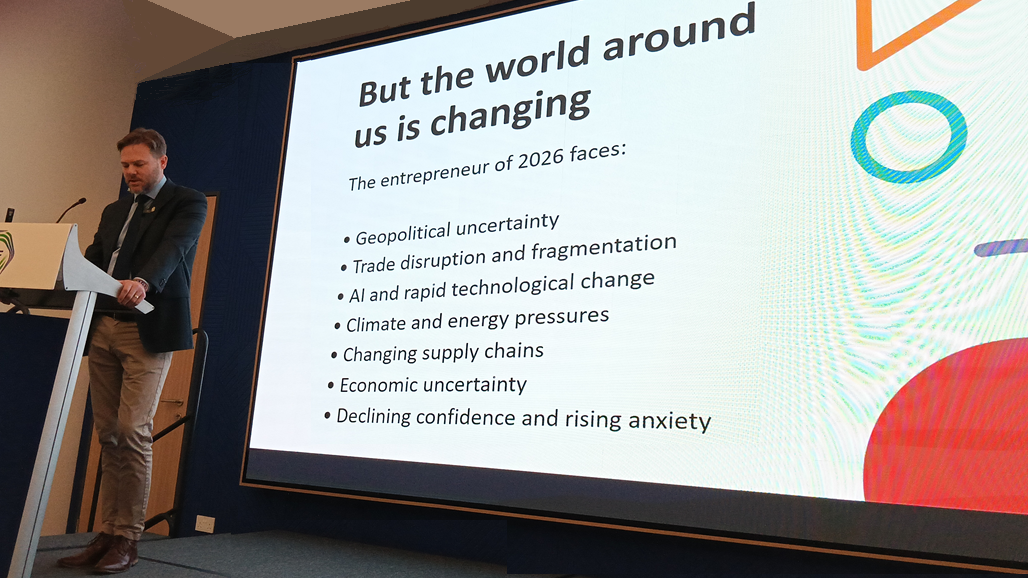
Mr. Stuart Thomson, CACCI Vice President for Entrepreneurship, shared his views and perspectives on fostering entrepreneurship, SME growth and regional collaboration models with SMF partners during CACCI Presidential visit to Singapore Manufacturing Federation (SMF) offices on the morning of 29 July 2026. The major points raised by Mr. Thomson included the following:
(1) Entrepreneurship and innovation are closely connected, but they are not the same. Innovation is about creating something new — a new product, a new process, a new business model, or simply a better way of doing something. Entrepreneurship is about acting on that possibility. An idea can remain an idea forever. An entrepreneur is the person who is prepared to do something with it.
(2) Innovation and entrepreneurship need each other. Innovation without entrepreneurship can remain an idea in a laboratory, a university, a boardroom or a notebook. Entrepreneurship without innovation can simply reproduce what already exists. But when the two come together, change is created. In the Asia-Pacific, much of the innovation that matters will not necessarily come from the largest companies. It will come from entrepreneurs and SMEs adapting to the world around them.
(3) The Asia-Pacific remains one of the great engines of the global economy. There is enormous growth, extraordinary innovation and immense opportunity. The question is: how do entrepreneurs pursue those opportunities in a world that is increasingly difficult to predict?
(4) The nature of competitive advantage is changing. Before, access to information and the right contact person was difficult to obtain. Today, thousands of businesses can be found online in minutes. Information is becoming abundant. Connections are becoming easier to find. But there is one thing technology has not made abundant.
(5) Trust will become one of the great currencies of entrepreneurship and innovation in our time. Because finding a business is easy. Knowing whether you should trust that business is much harder. Finding a person online is easy. Knowing how they will behave when something goes wrong is much harder. And in uncertain times, that becomes increasingly important.
 (6) Much innovation actually happens between people. It happens when people feel safe enough to share an unfinished idea; when people from different industries, countries and cultures bring different perspectives to the same problem. That requires something more than networking. It requires trust. And trust creates the conditions in which genuine innovation can occur.
(7) The future role of a chamber is not simply to be a connector. It is to become part of the trust infrastructure of the economy. Membership provides one level of reputational connection. It tells us that a business exists within a community and has some relationship with an institution. The future may increasingly be about stable, sustainable growth built on relationships capable of surviving disruption.
(8) This presents an enormous opportunity for CACCI and for chambers throughout the Asia-Pacific. They have something that technology cannot easily replicate. They have institutions. They have networks that cross borders. However, those networks need to be activated those networks, by creating repeated opportunities for people to develop genuine relationships.
(9) Entrepreneurship will continue to be one of the great drivers of innovation. Technology will continue to give entrepreneurs extraordinary new tools. But that does not make human relationships less important, but it makes them more important instead. In a world of unlimited connections, there is a need to know whom to trust.
(10) The role of entrepreneurship is to turn possibility into action. The role of innovation is to create new value. And perhaps one of the great roles of chambers of commerce in this next era is to create the trusted relationships in which both can flourish. The future of entrepreneurship in the Asia-Pacific will certainly be technological. It will certainly be innovative. But fundamentally, it will still be human. Ideas are everywhere. Trust is not.
The presentations made by Mr. Honrado, Ms. Kwan, and Mr. Thomson were followed by a Q&A session which was moderated by CACCI President McMullin. During the session, it was suggested to disseminate Mr. Honrado’s summary report to members, upload it in the CACCI website, and feature it in the ABA Newsletter.