VCCI & CACCI successfully hosted International Trade Risk Management courses in May 2026
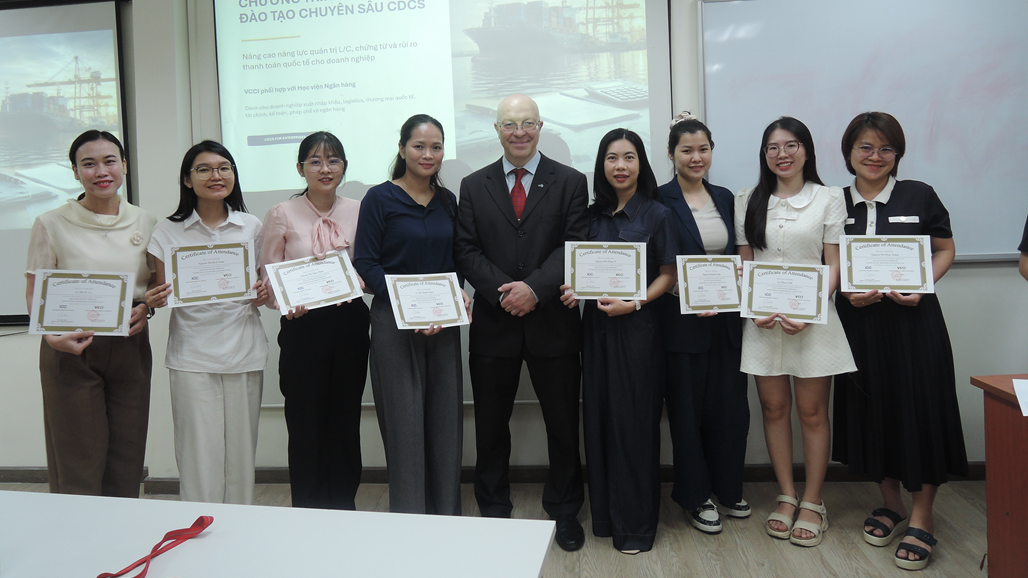
 The Vietnam Chamber of Commerce and Industry (VCCI), in cooperation with the Confederation of Asia-Pacific Chambers of Commerce and Industry (CACCI), recently organized a comprehensive two-day course on International Trade Risk Management. The program was successfully held in two of Vietnam's major economic hubs: first in Hanoi on May 18–19, 2026, and subsequently in Ho Chi Minh City on May 20–21, 2026.
Day 1: Contract Formulation, Incoterms, and Risk Mitigation
The session on May 18th was officially inaugurated by Mr. Nguyen Hoang Thang, Manager of the Digital Technology and Economy Department - Institute of Technologies and Innovation for Businesses (ITB), Vietnam Chamber of Commerce and Industry (VCCI). In his opening speech, he underscored the critical importance of selecting the right delivery and payment terms, alongside properly formulating trade contracts. He emphasized that the need to embrace best practices and international standards cannot be overstated in today's global economy.
The keynote speaker for the first day was Mr. Pavel Andrle, an international trainer, consultant, and long-time member of the ICC Banking Commission. The program was specifically designed to explore the relationship between, and proper choices regarding, delivery terms, corresponding payment terms, and risk mitigation tools such as guarantees, standby letters of credit, and insurance.
Significant time was also devoted to the transfer of title to goods and the strategic options available to contracting parties. This included an in-depth look at Retention of Title (RoT) clauses and how they function in the event of a buyer's payment default. While RoT clauses are highly effective tools that can protect sellers from financial disaster—particularly in cases of buyer insolvency—they also present numerous pitfalls and legal limitations. Mr. Andrle explained that the effectiveness of such clauses depends heavily on:
- How precisely they are drafted within the contract
- Whether the applicable governing law recognizes them
- How they are documented and processed throughout the specific transaction
Overall, the first day covered delivery terms according to Incoterms® 2020, standard payment methods (with a strong focus on documentary collections and documentary credits), and security instruments (including bank guarantees, standbys, cargo insurance, and credit insurance). The ultimate goal was to teach participants how to design optimal trade structures that protect both sellers and buyers against inevitable international trade risks.
Day 2: Professional Certifications and Supply Chain Finance
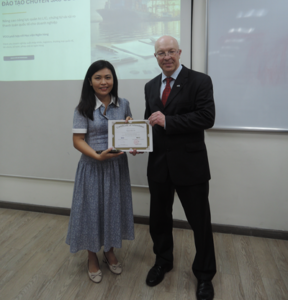 The second day also commenced with Mr. Pavel Andrle, who focused his presentation on leading professional international certifications and qualifications in the fields of international trade and finance. He introduced participants to various educational programs, examinations, and certifications provided by the ICC Academy and the London Institute of Banking & Finance (LIBF), which is now part of the Walbrook Institute London.
The remainder of the second day was delivered by local expert Mr. Doan Ngoc Thang, Dean of the Faculty of International Business in Hanoi. His presentations covered the core characteristics of Supply Chain Finance (SCF), examining how various SCF techniques align with corporate working capital needs and risk considerations. Furthermore, Mr. Doan Ngoc Thang elaborated on sustainable trade finance, providing numerous practical case studies that highlighted the integration of SCF and ESG (Environmental, Social, and Governance) criteria in real-world business operations.
Strong Turnout and Success
The courses met with great success and high engagement, attracting approximately 50 participants in Hanoi and more than 70 attendees in Ho Chi Minh City.